





ABOUT THE PROJECT
In July 1969, much of the world celebrated “one giant leap for mankind.” Fifty years later, nothing is quite so straightforward.
In Event of Moon Disaster illustrates the possibilities of deepfake technologies by reimagining this seminal event. What if the Apollo 11 mission had gone wrong and the astronauts had not been able to return home? A contingency speech for this possibility was prepared for, but never delivered by, President Nixon – until now.
In Event of Moon Disaster is an immersive art project inviting you into an alternative history, asking us all to consider how new technologies can bend, redirect and obfuscate the truth around us.
To construct the story a variety of techniques of misinformation were used – from simple deceptive editing to more complex deepfakes technologies.
To recreate the contingency speech, the piece used deep learning techniques to create both a synthetic voice of Nixon and to use dialogue replacement techniques to replicate the movement of Nixon’s mouth and lips.
By creating this alternative history the project explores the influence and pervasiveness of misinformation and deepfake technologies in our contemporary society.
THE INSTALLATION
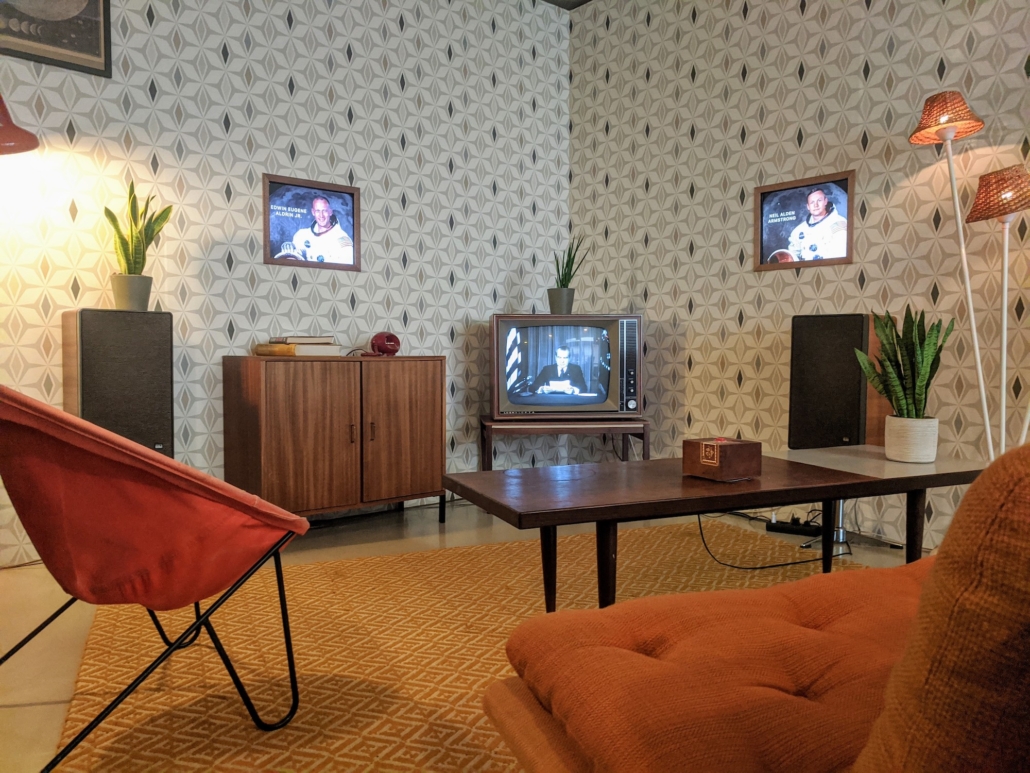
In Event of Moon Disaster premiered at IDFA DocLab on November 22, 2019 in the form of a physical installation designed to re-create a 1960s era American living room.
It has since been exhibited around the world. See Exhibitions for the full list.
THE TEAM
| Directors | Francesca Panetta, Halsey Burgund |
| Video Dialogue Replacement | Canny AI, Ltd |
| Voice Conversion Systems | Respeecher |
| Actor | Lewis D. Wheeler |
| Video Editing | Francesca Panetta, Jeff DelViscio, Laurence Topham, Halsey Burgund |
| Sound Editing | Francesca Panetta, Halsey Burgund |
| Supervising Sound Editor | Lukas Johnson |
| Re-recording Mixer, 5.1 Mix and Mastering | Lukas Johnson, Claes Nystrom |
| Motion Graphics | Dominic Smith |
| Colorist | Jim Fetela |
| Archive Researcher | Vanessa Vera, Steve Bergson |
| Senior Writer | Pakinam Amer |
| Writers | Betsy Willett, JJ Otto, Francesca Panetta, Halsey Burgund, James Burke, Cindy Bishop, Arwa Michelle Mboya, Karen Hao, Anica Butler, Steve Wilmsen, Joshua Glick, Andrew Dickson |
| Newspaper Copy Editing | Anica Butler, Steve Wilmsen |
| Website Copy Editing | Rachel E. Gross |
| Web Development | Taylor Snead, Dylan Halpern, Halsey Burgund |
| Web UI Design | Ksenia Slavina, Tyler Smith |
| Web UX Design | Jeff Soyk |
| Graphic Design | Zoe Pruitt, Jeff DelViscio |
| Concept Design | Magnus Bjerg, Jeff DelViscio, Francesca Panetta, Halsey Burgund |
| Newspaper Project Manager | JJ Otto |
| Newspaper Design | Betsy Willett |
| Installation Producer (Tribeca) | Danny Goldfield |
| Installation Design (Tribeca) | Hans Maharawal |
| Production Manager | Penny Benatovich |
| Marketing | Patty Wittenburg, Janine Liberty, Kate Stringer |
| Video Consultancy | Chris Boebel |
| Education Producer | Joshua Glick |
| Administration | Megan Parnell |
| Project Supervisor | D. Fox Harrell |
EDUCATIONAL RESOURCES
How to Strand Astronauts on the Moon, a short film commissioned by Ars Electronica in 2021, follows the journey of making the deepfake.
The project has also been adapted and used in teaching materials beyond this site:
- Media Literacy in the Age of Deepfakes: a learning module from the MIT Center for Advanced Virtuality, designed by Joshua Glick, with the project as its central case study.
- da.moondisaster.org: the Danish edition of the project site, made with the Danish Film Institute and Filmcentralen.
- Kan du spotte en deepfake?: a lesson from Tjek det (in Danish).
- Real Fake: a graphic novel in the US Cybersecurity and Infrastructure Security Agency’s Resilience Series (PDF).
A Production of:

Supported By:






Co-Directed by Francesca Panetta and Halsey Burgund | An MIT Center for Advanced Virtuality production

This work is licensed under a Creative Commons Attribution-NonCommercial-NoDerivatives 4.0 International License.